
Last Updated: October 16, 2026: This article is based on Tesla’s official reveal event (October 15, 2026) and reporting from CNN, Car and Driver, TechCrunch, MotorTrend, and the BBC.
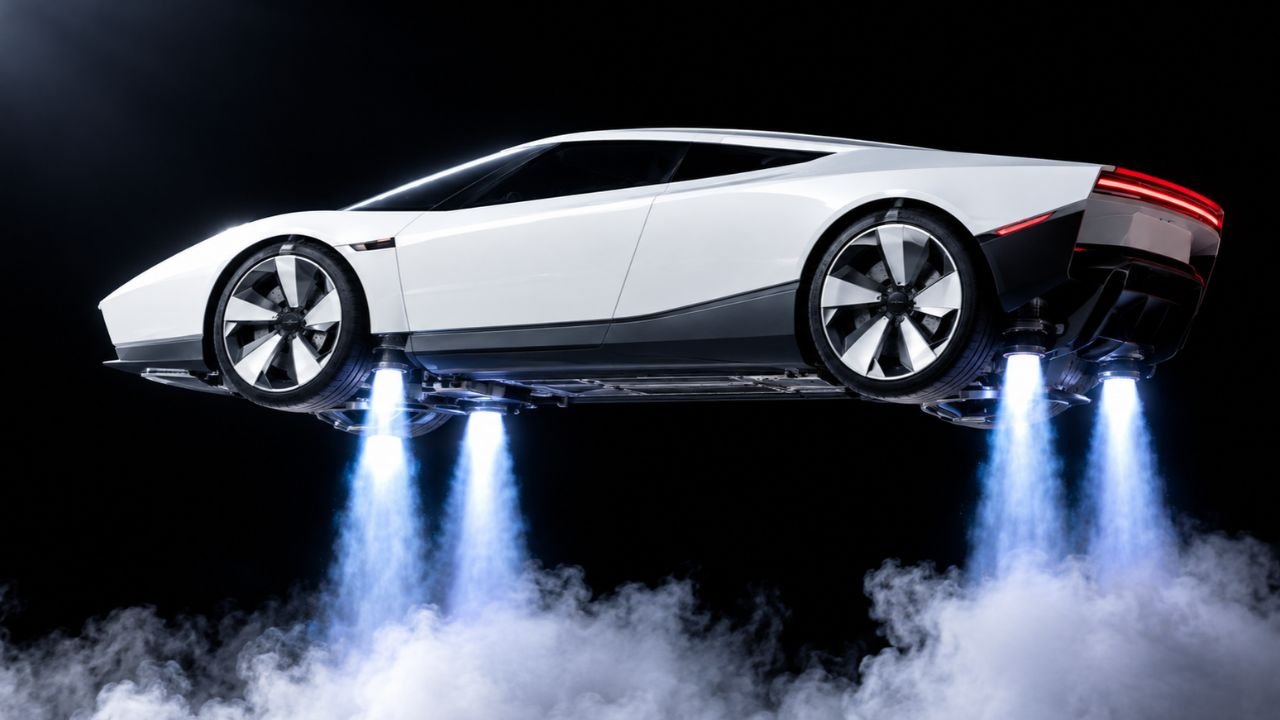
On the night of October 15, 2026, Elon Musk finally pulled the cover off the car fans had been waiting nine years to see: the new Tesla Roadster. It wasn’t just another fast sports car. In the demo, a Roadster drove up an inverted ramp, launched into the air, did a barrel roll, hopped over a row of other Teslas, and settled gently back onto the pavement in a cloud of white vapor. Within hours, “Tesla flying car” was trending worldwide.
That left everyone asking the same questions: Is the Tesla flying car real or fake? Can it actually fly? How much does it cost, when can you get one, and is it even legal? In this guide, we answer every one of those questions using official facts, and we clearly separate what’s confirmed from what’s still just hype or rumor.
⚡ Quick Answer: Is the Tesla Flying Car Real or Fake?
The car is real, but “flying car” is only half the story. Tesla announced three versions of the new Roadster: Performance, Thrust, and Rocket. Only the Rocket version is claimed to “fly,” and it will be available by invitation only. It doesn’t fly like an airplane. It uses compressed-air thrusters to hop and hover for a few seconds at a time. Musk says production starts in 2028, and the final price hasn’t been announced.
1. The Tesla Roadster Reveal: What Happened on October 15, 2026?
Tesla originally scheduled the Roadster event for October 1, 2026, but bad weather pushed it back to October 15. The event took place at SpaceX’s rocket development facility in McGregor, Texas, near Waco, in front of a select group of fans, media, and investors. It was livestreamed on X and Tesla’s website. The start time of 7:55 p.m. CT was a nod to Back to the Future.
Musk explained why a live crowd was there: “We need an audience to prove that it’s not AI.” He also tempered expectations before the stunt: “Success is not guaranteed… It’ll probably work, but if it doesn’t work, we’re at a safe distance.”
What Tesla showed in the demo
- Driving up an inverted ramp: The Roadster climbed a towering, Hot Wheels-style ramp that curved back on itself. Tesla says a suction fan system under the car pins it to the surface, even when it’s upside down.
- Barrel roll and landing: The car launched off the top of the ramp, rolled in midair, and used its thrusters to touch down softly.
- Jumping over other Teslas: The Roadster used its thrusters to hop over a Cybercab, Cybertruck, Tesla Semi, Model Y, and Model 3 while moving (TechCrunch).
- 0–60 mph runs: The first run took about 1 second. After Musk was reminded he had promised “under one second,” a second run clocked in at roughly 0.8 seconds (about 0.81s) (Car and Driver).
- No one behind the wheel: The demo car had no driver on board. In Musk’s words, the setup was “to make sure we don’t kill anyone” (CNN).
Musk joked that “this is not necessarily a safety-optimized car, but it takes the fun meter to 11 out of 10.” He also called it “the best of the last of the human-driven cars,” a hint that Tesla sees the Roadster as a send-off for human driving as the rest of its lineup moves toward autonomy.
Joining Musk on stage were Tesla’s chief designer Franz von Holzhausen and Vice President of Vehicle Engineering Lars Moravy, the two most visible faces of the project.
2. Is the Viral Tesla Flying Car Video Real or AI? (Full Fact-Check)
This is where most of the confusion comes from. Two very different kinds of videos are going viral right now, and you need to keep them separate.
✅ What’s confirmed
- The event was real. CNN, the BBC, CNBC, TechCrunch, and Car and Driver all covered it, and a live audience was on site.
- The Federal Aviation Administration (FAA) issued a Temporary Flight Restriction (TFR) over the McGregor facility for the original October 1 date. It covered a 1.5-nautical-mile radius up to 10,000 feet (MotorTrend), a strong sign that something was going to leave the ground.
- Tesla’s official X post describing the Rocket version says: “yes, it can fly.”
⚠️ What’s been questioned
- Was the stunt fully live? Some critics, including a reviewer at Autonocion, said the stunt portion happened away from the crowd, in the dark, and looked like pre-recorded footage on the screens. Tesla hasn’t addressed that claim directly.
- Two different cars: Car and Driver noted that the stunt car and the car displayed on stage weren’t the same vehicle. The stunt car wore simple Cybercab-style hubcaps, while the show car had more detailed wheels. That’s normal for prototypes, but it shows the production car isn’t finished.
- Flying or hopping? Roger Connor, curator of vertical flight at the Smithsonian’s National Air and Space Museum, told CNN: “We’re not talking about sustained flight. We are literally talking about hopping.” Tesla didn’t demonstrate any sustained flight.
🤖 How to spot AI-generated fake videos
Since the reveal, social media has been flooded with AI videos showing a Roadster flying over traffic jams or cruising above city skylines. Those are fake. Tesla has never shown sustained flight like that. Here’s how to tell the difference:
- License plates, logos, or text look warped or keep changing.
- The car flies over a city for a long time in broad daylight. The real demo took place at night in a closed test area.
- There’s no visible vapor from the thrusters, or the car seems to fly on propellers.
- The source isn’t Tesla, Elon Musk’s X account, or a major news outlet.
Our verdict: The event was real and the car is a physical prototype. But “Tesla flying car” doesn’t mean a car you can fly from your driveway to the office. So far, Tesla has shown short hops and stunts lasting a few seconds.
3. Tesla Roadster Performance vs. Thrust vs. Rocket: What’s the Difference?
Tesla is offering the Roadster in three configurations. Only the Rocket is claimed to fly, and that’s where a lot of people get confused.
| Feature | Performance | Thrust | Rocket |
|---|---|---|---|
| Tesla’s tagline | Road ready | Race ready | Air ready |
| Seats | 2 | 2 | 1 (driver only) |
| 0–60 mph (claimed) | Under 1.6 sec | Under 0.9 sec | Under 0.59 sec |
| Active aero + suction fan | Yes | Yes | Yes |
| Cold-gas thrusters | No | Rear-mounted | 10 around the car |
| Can fly/hover | No | No | Yes (Tesla’s claim) |
| Availability | Reservations open | Limited release | Invitation only |
| Reservation amount | $50,000 | $250,000 | Invitation only |
According to Tesla, all three versions will have more than 300 miles of range. Top speed is listed at more than 230 mph, and Tesla’s official listing ties that figure to the Rocket. Musk said his goal is to eventually reach half the speed of sound (around 383 mph).
4. 2028 Tesla Roadster Specs: Design, Interior, and Technology
| Spec | Details | Status |
|---|---|---|
| 0–60 mph | Under 0.59 to under 1.6 sec, depending on version | Tesla claim |
| Demo time | About 0.81 sec | Shown at event |
| Top speed | 230+ mph | Tesla claim |
| Range | 300+ miles | Tesla claim |
| Thrusters | 10 cold-gas nozzles (Rocket) | Official |
| Air storage | About 600 liters of compressed air in carbon fiber tanks (COPVs) at 10,000 psi | Lars Moravy via MotorTrend |
| Thrust force | More than 80 kilonewtons | Car and Driver report |
| Doors | Butterfly-style | Official |
| Roof | T-top with removable glass panels | MotorTrend |
| Steering | New angular yoke (suede/leather) | Official |
| Battery size (kWh) | Not announced | Pending |
| Motors | Production specs not announced | Pending |
| Curb weight | Not official. Marques Brownlee described it as “4000+ pound” | Unofficial |
| Colors | White and red cars were shown. No official color list yet | Pending |
| Final price | Not announced | Pending |
⚠️ Important: You’ll still see specs online like “200 kWh battery, 620 miles of range, four seats, 0–60 in 1.9 seconds.” Those come from the 2017 concept, not the new Roadster. The new car is a two-seater (the Rocket is a single-seater), and Tesla lists its range at 300+ miles.
Design: inspired by James Bond and fighter jets
The new Roadster is a complete departure from the 2017 concept. The curvy, Coke-bottle shape is gone, replaced by a sharp, classic supercar wedge profile. Tesla cites the SR-71 Blackbird spy plane and the F-35 fighter jet as inspiration. Franz von Holzhausen also pointed to the white 1976 Lotus Esprit S1 from the 1977 James Bond film The Spy Who Loved Me. Musk owns the movie’s submarine-car prop, and it was on display at the event.
Hidden in the tail is a large active rear wing with high-drag and high-downforce modes that adjusts its angle automatically. The suction fan system underneath has two modes as well: one that holds the car to the ground at low speeds and another that boosts underbody airflow at high speeds. MotorTrend reports that the car uses cameras instead of side mirrors, though physical mirrors will be added to meet US regulations. Even the wiper is hidden below the windshield until you need it.
Interior
Inside are two lightweight seats with minimal adjustments and race-car-style floor-mounted pedals. A large driver-angled touchscreen sits in the center, and a “Mars red” information bar along the base of the windshield cycles through speed, range, and temperature. Tesla says there’s room for two carry-on suitcases behind the seats, as long as that space isn’t taken up by an air tank.
5. How Does the Tesla Roadster Fly? The Physics of SpaceX Cold-Gas Thrusters
A lot of people assume the Roadster has a rocket engine or jet fuel on board. It doesn’t. It uses cold-gas thrusters, the same basic technology SpaceX uses to keep Falcon 9 boosters and Starship oriented in flight.
How SpaceX thrusters work (in plain English)
Blow up a balloon and let it go. Air rushes out one way, and the balloon shoots off the other way. That’s Newton’s third law: every action has an equal and opposite reaction. A cold-gas thruster works the same way, except instead of a balloon, it uses carbon fiber tanks pressurized to 10,000 psi, nearly 300 times the pressure in your car’s tires. When a valve opens, the gas blasts out of a nozzle and pushes the car in the opposite direction. Nothing burns, which is why it’s called “cold” gas.
Tesla says an onboard compressor can refill the tanks on its own. Lars Moravy said the car stores about 600 liters of compressed air. Tesla put it this way on X: “Every usable void in the car is packed with Carbon Fiber Overwrapped Pressure Vessels (COPVs).” The white cloud you see during landing is most likely condensation from rapidly expanding, cooling air, not smoke.
What does 0.81 seconds actually mean? (Quick math)
60 mph is about 26.8 meters per second. Hitting that speed in 0.81 seconds means an average acceleration of roughly 33 m/s², or about 3.4 g. The driver would be pressed into the seat with about three and a half times their body weight, which is close to what fighter pilots experience. Normal tires can’t deliver that kind of grip, which is exactly why Tesla relies on suction fans and thrusters.
How long can it stay in the air? (Our estimate)
Tesla hasn’t released an official flight time, but basic physics gives us a rough idea. Holding a car of about two tons in the air takes roughly 20 kilonewtons of continuous thrust. Even at 10,000 psi, 600 liters of air is a limited supply, and cold-gas thrusters are inefficient compared to fuel-burning engines. By our rough math, a full tank would provide a few seconds of hover (likely under 10 seconds). That’s our educational estimate, not an official figure, but it explains why experts are calling this “hopping” rather than “flying.”
6. Tesla Roadster Price, Reservations, and Who Can Buy One
Tesla hasn’t announced a final price. The reservation amounts alone make it clear this will be a very expensive car.
| Version | Reservation | How it works |
|---|---|---|
| Performance | $50,000 | $5,000 due today (refundable) + $45,000 within 10 days |
| Thrust | $250,000 | Limited release |
| Rocket | N/A | Invitation only |
The 2017 $200,000 price and the $250,000 Founders Series
When the concept debuted in 2017, Tesla quoted a base price of about $200,000. It also collected the full $250,000 up front from buyers of 1,000 Founders Series cars, and some of those buyers have now been waiting nine years. According to Business Insider, if someone had put that same $50,000 reservation into Tesla stock in 2017, it would have been worth roughly $850,000 to $900,000 by October 2026.
Reservation refund complaints
The repeated delays led some high-profile reservation holders to complain publicly, including YouTuber Marques Brownlee (MKBHD) and OpenAI CEO Sam Altman. Altman previously posted about having trouble getting his reservation refunded. If you’re thinking about reserving one, read Tesla’s current refund terms on tesla.com before you pay.
Who will actually buy one?
This isn’t a car for the average driver. The realistic buyers are hypercar collectors, the ultra-wealthy, celebrities, and longtime Tesla superfans. Because the Rocket is invitation-only, it will likely go to a small circle of select customers. Musk himself said the Roadster won’t move the needle much on revenue. It’s Tesla’s “halo car,” built to boost the brand rather than the bottom line.
7. Tesla Roadster Release Date: When Does Production Start?
At the event, Musk said production will begin in 2028, adding “actually” with a laugh. Given the Roadster’s history, the joke makes sense:
| Date | What happened |
|---|---|
| Nov. 2017 | Surprise reveal at the end of the Tesla Semi event, with deliveries promised for 2020 |
| June 2018 | Musk tweets about a “SpaceX option package” with ~10 rocket thrusters: “Maybe they will even allow a Tesla to fly” |
| 2020–2024 | Repeated delays as Tesla prioritized Model 3 “production hell,” Model Y, and Cybertruck |
| Nov. 2025 | Reveal pushed to April 1, 2026. Musk joked April Fools’ Day would give “deniability” |
| Sept. 2026 | Reveal set for October 1 and $50,000 reservations reopened |
| Oct. 1, 2026 | Event postponed due to weather |
| Oct. 15, 2026 | The Roadster is finally revealed |
| 2028 | Production start, according to Musk |
Our take: Based on Tesla’s history, it’s hard to treat 2028 as a firm date. The Performance version will likely arrive first. The Rocket faces the biggest legal and safety hurdles, so it’s probably the last to arrive and will be built in very small numbers.
Where will it launch first?
Tesla hasn’t named launch markets, but new Tesla models almost always debut in the United States first, and the reveal happened in Texas. Europe, the Middle East (especially the UAE), and other markets will depend on local regulations, particularly for the thruster-equipped versions.
8. Is the Tesla Flying Car Legal? Licenses, the FAA, and Airspace Rules
The most honest answer came from Musk himself: “I’m not sure it’s necessarily legal in all jurisdictions, but there will be such a car that someone can own.” According to Teslarati, Tesla’s listing also notes that the car is not yet approved for public road use.
The FAA’s “an inch off the ground” problem
As MotorTrend points out, in the US anything that lifts off the ground, whether by two inches or two thousand feet, can fall under the FAA’s definition of an aircraft. Under the FAA’s newer rules for eVTOL and powered-lift aircraft, these vehicles are expected to operate on approved routes, away from regular traffic. As of now, there’s no public record of an FAA type certificate for the Tesla Roadster.
Do you need a pilot’s license or just a driver’s license?
- Performance and Thrust: These are ground vehicles. If they’re certified as street legal, a standard driver’s license should be enough, though insurers may require extra training for a car this powerful. Whether states will allow rear-mounted thrusters on public roads is still an open question.
- Rocket (flight features): If the car truly leaves the ground, aviation rules could apply, which might mean a pilot certificate, airspace authorization, and possibly a TFR. Many analysts expect the flight features to be limited to private property or closed tracks.
Disclaimer: This is not legal advice. Laws vary by state and country, and final rules from Tesla and regulators have not yet been published.
Traffic rules and air traffic control
A car suddenly lifting off a public road creates obvious hazards for other drivers, pedestrians, and overpasses. Flying from anywhere would require an air traffic system that simply doesn’t exist for private cars in any country today. For the foreseeable future, the Roadster’s “flying” looks like a track or showcase feature, not something you’d use on your commute.
9. Safety, Weather, and Real-World Problems
Safety: emergency landings, parachutes, and crash risk
Tesla hasn’t shared any details about emergency landing systems, parachutes, or airbags. Musk has said in a past interview, “If safety is your number one goal, do not buy the Roadster,” and that Tesla will “aspire not to kill anyone in this car.” The COPV tanks are another concern. TechCrunch noted that similar pressure vessels have been linked to some SpaceX rocket failures. Tesla still has to prove what happens to a 10,000 psi tank in a crash.
Possible emergency scenarios
- Running out of air mid-hop: The thrusters only have a few seconds of air. If it runs out at the wrong moment, the car could drop, so the software would need to always reserve enough air for landing.
- A thruster failure: If a nozzle on one side fails, the car could tilt or spin. That’s an aircraft-level engineering problem.
- Suction fan failure: On an inverted ramp or a high-speed corner, a fan failure means a sudden loss of grip.
- Software bugs or cyberattacks: Computers control the thrusters, fans, and wing. A bug or a hack could be far more dangerous here than in a regular car.
Weather: rain, wind, snow, and fog
The best evidence here is that the Roadster’s own launch event was postponed because of bad weather. Strong winds make even a short hover difficult, rain and snow affect both suction and tire grip, and fog degrades camera-based systems. If the car couldn’t launch because of the weather, expecting it to “fly” in any conditions is premature.
Battery, charging, and “fuel”
The Roadster is fully electric, so it charges at Tesla Superchargers or a home charger, with no gas required. The thrusters don’t need separate fuel either, since an onboard compressor refills the tanks. But the compressor runs on battery power, so heavy thruster use will likely cut into range. Tesla hasn’t said how long a tank refill takes.
How many passengers?
The Performance and Thrust versions seat two. The Rocket seats only one: the driver.
Noise and environmental impact
As an EV, the Roadster will be quiet and produce zero tailpipe emissions during normal driving. But high-pressure air blasting from nozzles creates a very loud hiss or bang, and the suction fans add noise of their own. That could be a problem in residential areas. Its overall carbon footprint will depend on how the electricity it uses is generated.
Parking, landing zones, and charging
The Performance and Thrust versions can use regular parking spaces and Tesla’s Supercharger network. Flying the Rocket would require open, safe, authorized areas, and no city has designated “landing zones” for cars.
Maintenance, repairs, and insurance
Official ownership costs aren’t available yet. But inspections of carbon fiber pressure tanks, specialized fans and thrusters, and hypercar-grade parts all point to expensive maintenance. Insurers have never covered anything quite like this. Coverage for the flight-capable version could be very costly, or hard to get at all.
10. A Brief History of Flying Cars: Where Did the Idea Come From?
Was this Elon Musk’s original idea?
The flying car dream is much older than Musk. Engineers have been building them since the 1940s, and pop culture from The Jetsons to Back to the Future kept the fantasy alive. Musk’s twist was putting SpaceX rocket thrusters on a sports car, an idea he first floated on Twitter in June 2018. At the event, he admitted: “When I suggested this to the team, I thought, ‘Am I crazy?'”
A fun bit of history: in February 2018, SpaceX launched Musk’s own cherry-red original Tesla Roadster into space on a Falcon Heavy rocket, with a mannequin named “Starman” in the driver’s seat. The new Roadster brings that Tesla-SpaceX connection full circle.
Who tried before, and how did it go?
| Project | Country | Outcome |
|---|---|---|
| Taylor Aerocar (1949) | USA | It both drove and flew, but never reached mass production because it couldn’t attract investors |
| Terrafugia Transition | USA | Folding-wing prototypes flew. China’s Geely bought the company in 2017, but large-scale sales never happened |
| AeroMobil | Slovakia | Several prototypes, including one that crashed during testing in 2015. Still awaiting commercial launch |
| Klein Vision AirCar | Slovakia | Flew between two cities in 2021 and received an airworthiness certificate in Slovakia in 2022 |
| PAL-V Liberty | Netherlands | Gyroplane-car hybrid, still working toward road approval in Europe |
| Alef Model A | USA | Received a limited FAA special airworthiness certificate in 2023 and is taking pre-orders |
The lesson: building a flying car is possible. Making one that’s safe, legal, affordable, and practical is the hard part, and that’s where most projects have failed.
11. Tesla vs. the Competition: Alef, Joby, and Archer
| Company / Model | Type | How it flies | Status |
|---|---|---|---|
| Tesla Roadster Rocket | Sports car with hop capability | Compressed-air thrusters | Prototype, invitation only, production in 2028 (claimed) |
| Alef Model A | Road car + eVTOL | Eight propellers inside the body | Limited FAA certificate, testing ongoing |
| Joby Aviation | Air taxi (not a car) | Electric propellers (eVTOL) | Preparing for commercial service |
| Archer Midnight | Air taxi (not a car) | Electric propellers (eVTOL) | Preparing for commercial service |
The biggest difference is that Joby and Archer don’t drive on roads. They’re pilot-operated air taxis. Alef is closer to a true flying car, but CNN notes its vehicle is extremely lightweight and carries only one person. Alef CEO Jim Dukhovny told CNN that getting Tesla’s car off the ground is “100% feasible,” but that the hardest part is the transition from vertical lift to forward flight while staying stable and not losing lift.
12. Tesla Roadster vs. Rimac Nevera R vs. Bugatti
| Car | Acceleration (manufacturer claim) | Top speed (claim) | Thrusters |
|---|---|---|---|
| Tesla Roadster Rocket | 0–60 mph in under 0.59 sec | 230+ mph | Yes |
| Tesla Roadster Performance | 0–60 mph in under 1.6 sec | Not announced | No |
| Rimac Nevera R | 0–62 mph in about 1.8 sec | About 256 mph | No |
| Bugatti Tourbillon | 0–62 mph in about 2.0 sec | About 276 mph | No |
Has there been a drag race? Not yet. No real, independent drag race between the new Roadster and a Rimac or Bugatti has happened. Any video claiming otherwise is either old footage, edited, or AI-generated. It’s also not an apples-to-apples comparison: Rimac and Bugatti numbers come from tire grip alone, while Tesla’s fastest figures rely on thrusters. Racing organizations may not even allow a thruster-equipped car in standard categories.
Musk claims the Roadster is “going to crush every track record that has ever existed.” That claim will only be proven when independent testers get their hands on a production car.
13. Regular Car vs. Helicopter vs. Flying Car: Comparison Table
| Factor | Regular Car | Helicopter | Flying Car (e.g., Roadster Rocket) |
|---|---|---|---|
| License | Driver’s license | Pilot certificate | Unclear, possibly both |
| Drives on roads? | Yes | No | Yes (once approved) |
| Flight time | — | Hours | Seconds (hops) |
| Parking | Standard parking | Helipad | Standard parking, special areas to fly |
| Cost | $25,000–$100,000+ | $1 million+ | Likely hundreds of thousands to millions |
| Weather sensitivity | Low | High | High |
| Daily practicality | Very high | Limited | Very low for now |
Tesla Roadster vs. a true flying car
A true flying car can take off from a road and fly from one place to another, as the Klein Vision AirCar did between two cities. The Tesla Roadster is really a super-fast sports car whose Rocket version can hop, hover, and perform stunts using thrusters. In the Smithsonian expert’s words, it’s “hopping,” not “flying.”
14. Elon Musk’s Past Promises and Tesla’s Track Record
What Musk actually said
“SpaceX option package for new Tesla Roadster will include ~10 small rocket thrusters arranged seamlessly around car. These rocket engines dramatically improve acceleration, top speed, braking & cornering. Maybe they will even allow a Tesla to fly…”
Elon Musk, Twitter, June 2018
“If you buy a Ferrari, safety is not the number one goal. I say, if safety is your number one goal, do not buy the Roadster.”
Elon Musk, podcast interview
“This is the culmination of incredible work by Tesla and SpaceX engineers working closely together to make something you haven’t seen in any movie, better than any James Bond car.”
Elon Musk, Roadster reveal, October 15, 2026
Musk also floated the idea of having the Roadster jump Idaho’s Snake River Canyon, the same gorge Evel Knievel famously tried to clear in a steam-powered rocket in 1974.
Tesla’s past vehicles: hits and misses
| Vehicle | Outcome |
|---|---|
| Original Roadster (2008) | Tesla’s first car. Built in small numbers, but it proved electric sports cars could work |
| Model S (2012) | A major success that reshaped the luxury EV market |
| Model 3 (2017) | Early “production hell,” then a massive hit |
| Model Y (2020) | Became the world’s best-selling vehicle in 2023 |
| Cybertruck (2023) | Years late, and described by TechCrunch as a “commercial flop” by Tesla’s own standards |
| Tesla Semi | Revealed in 2017, with high-volume production still slow |
| Roadster (2nd gen) | Promised for 2020, now targeted for 2028 |
The pattern is clear: Musk’s vehicles usually do arrive, but rarely on time, and the final specs often differ from the original promises.
15. Social Media Reactions, Memes, and Why It Went Viral
Early in the livestream, roughly 161,000 people were watching on X and 185,000 on Tesla’s website (Autonocion). Clips then spread across Instagram, Facebook, YouTube, and TikTok. No reliable figure for total views exists yet.
The most talked-about reactions
“They really just got on stage and said this newly designed 4000+ pound car can do flips and go half the speed of sound (380+mph) and will ship in 2028. This is a prank, right?”
Marques Brownlee (MKBHD), on X
- Toll booth memes: Posts like “Toll plazas aren’t going to like this one” racked up shares.
- Traffic stop memes: Cops trying to pull over a car that’s hovering in midair.
- “Me on Monday morning”: AI clips of a Roadster flying over rush-hour traffic. These are jokes, not real footage.
- Fans vs. skeptics: Fans called it the coolest car reveal ever, while skeptics called it “smoke and mirrors.”
Why did this blow up?
Four things came together: the childhood dream of a flying car, the Elon Musk name, a nine-year wait, and a “real or AI?” debate that made people rewatch and share the clips. That’s why searches like “Tesla flying car real or fake,” “Tesla Roadster price,” and “Tesla Roadster 0.81 seconds” spiked on Google.
Reviews and ratings: No customer has driven this car yet, so no genuine owner reviews or ratings exist. If you see a “Tesla Roadster review: 5 stars” anywhere right now, don’t trust it.
16. Impact on the US Market, the Auto Industry, and a Possible Tesla-SpaceX Merger
The Roadster is a halo car. It won’t make Tesla much money directly, but it generates enormous attention and brand buzz. It’s also the first product to combine Tesla and SpaceX engineering this closely, which has revived Wall Street speculation about a merger between the two companies (Investor’s Business Daily). To be clear, that’s purely speculation. No merger has been announced.
For the wider industry, the Roadster could push hypercar makers to invest more in active aero and “fan car” technology. Thruster-equipped cars are unlikely to go mainstream, though, given the safety and legal hurdles. Some analysts also see the Roadster as Tesla’s way of rewarding longtime enthusiasts as the company shifts its focus toward autonomous vehicles and robotics.
What experts and engineers are saying
- Roger Connor (Smithsonian): “Aircraft are extremely sensitive to weight, whereas with ground vehicles you want them to have bumpers and crumple zones.” He added that hybrids often end up as a “poor performing aircraft and a poor performing vehicle,” and an expensive one.
- Jim Dukhovny (Alef CEO): Getting off the ground is “100% feasible,” but the transition from vertical to forward flight is the hardest part.
- MotorTrend: Because of FAA rules, the Roadster is more likely to hover and hop than to fly like a Harrier jump jet.
Pros and cons
| ✅ Pros | ❌ Cons |
|---|---|
| Claims the quickest acceleration of any car ever | Final price and full specs are still unknown |
| Fully electric, with no gas required | Flight features face major legal hurdles |
| Thrusters refill themselves without fuel | Only one or two seats |
| Futuristic design and technology | Musk admits safety isn’t the top priority |
| A one-of-a-kind car for collectors and track use | A long history of delays, with production not until 2028 (claimed) |
17. Official Facts vs. Rumors
✅ Official / Confirmed
- Revealed October 15, 2026, in McGregor, Texas
- Three versions: Performance, Thrust, and Rocket
- 300+ miles of range and 230+ mph top speed (claimed)
- Thrusters run on compressed air, not rocket fuel
- Reservations: $50,000 (Performance) and $250,000 (Thrust)
- Production in 2028 (per Musk)
❓ Rumor / Unconfirmed
- It can fly over cities for long distances: False, that only happens in AI videos
- The price is $200,000: That’s the 2017 figure, not the new price
- Tesla-SpaceX merger: Speculation only
- The FAA has approved it: No public record exists
- Whether the entire demo was live or pre-recorded: Still debated
- International launch dates: Not announced
18. Frequently Asked Questions
Can the Tesla Roadster really fly?
Tesla only claims the Rocket version can fly. At the reveal, the car jumped, rolled in midair, and landed softly, but it didn’t demonstrate sustained flight. Experts describe it as “hopping.”
How much does the Tesla flying car cost?
The final price hasn’t been announced. Reservations are $50,000 for the Performance and $250,000 for the Thrust, while the Rocket is invitation only.
When will the new Tesla Roadster be released?
Elon Musk says production will begin in 2028. The Roadster has been delayed several times before, so that date could slip.
How fast does the Tesla Roadster go from 0 to 60?
Tesla claims under 1.6 seconds for the Performance, under 0.9 seconds for the Thrust, and under 0.59 seconds for the Rocket. The demo recorded about 0.81 seconds.
Is the Tesla flying car street legal?
Not yet. Musk said it may not be “legal in all jurisdictions,” and Tesla’s listing notes it isn’t approved for public roads. Any flight would likely require FAA approval.
Do you need a pilot’s license to drive the Tesla Roadster?
The ground-only versions will likely just need a regular driver’s license. Using the flight features could fall under aviation rules. Final rules haven’t been set.
Does the Tesla Roadster use rocket fuel?
No. It uses cold-gas thrusters powered by air compressed to 10,000 psi, and an onboard compressor refills the tanks.
How many people can ride in the Tesla Roadster?
Two in the Performance and Thrust, and only one (the driver) in the Rocket.
What is the Tesla Roadster’s range?
Tesla says more than 300 miles. Heavy use of the thrusters will likely reduce that.
What colors will the Tesla Roadster come in?
White and red cars were shown at the event, but Tesla hasn’t released an official list of color options.
Will the Tesla Roadster be sold outside the US?
Tesla hasn’t announced international markets. The US is expected to come first, with other countries depending on local regulations.
Are the viral flying Tesla videos real or AI?
Clips from Tesla’s official event are real, but they only show hops and stunts. Videos of a Roadster flying over cities or traffic are AI-generated or edited.
Conclusion: Is Elon Musk’s Flying Car Really Coming?
Short answer: Yes, but not the way you’re picturing it. The new Tesla Roadster is a real prototype with a claim to the quickest acceleration of any car ever, a striking design, and SpaceX thruster technology. The Rocket version hopped, rolled in midair, and landed gently. As a piece of engineering, that’s genuinely remarkable.
But it isn’t the flying car that will carry you over traffic to work. Flights last only seconds, the Rocket is invitation only, the price is unknown, legal approval is unclear, and production won’t start before 2028, possibly later.
Is it a practical purchase? Not for most people. This is a collector’s hypercar and a technology showcase. If you want a great electric car for everyday driving, a regular EV makes far more sense. But if you love future tech and Elon Musk’s “impossible” projects, the next two years of Roadster news will be fun to follow.
We’ll update this article as Tesla releases new official information. What do you think: is the Tesla Roadster a real flying car or just a spectacular stunt? Let us know in the comments.
📚 Sources and References
- Tesla – Official Roadster Page
- Tesla – Roadster Reservation Page
- CNN – Tesla unveils what it says is a flying car
- Car and Driver – New Tesla Roadster Takes Flight with SpaceX Thrusters
- TechCrunch – Tesla reveals SpaceX-powered Roadster
- MotorTrend – 2028 Tesla Roadster First Look
- MotorTrend – Could the Tesla Roadster Actually Fly? (FAA)
- BBC – Did Tesla really just unveil a flying car?
- Teslarati – Tesla Roadster: Three configs
- Autonocion – Critical review of the live demo
- FAA – Air Taxis / Powered-Lift FAQ
Disclaimer: This article is for informational purposes only. Specs, prices, and dates are based on Tesla’s claims and news reports and may change. Nothing here is financial or legal advice.